

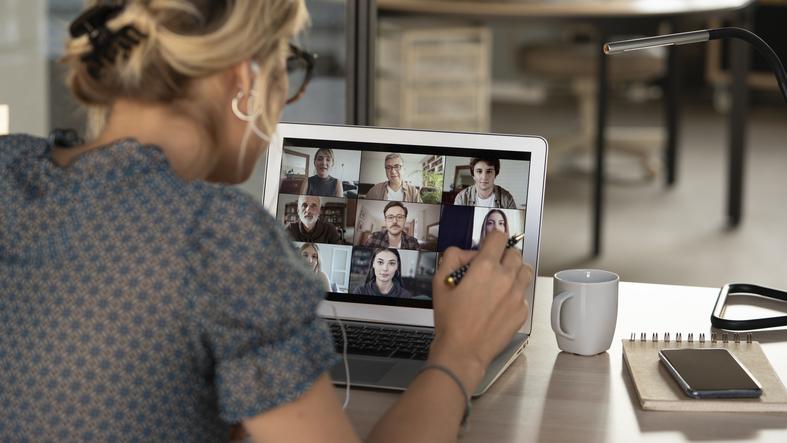
Much of the conversation around online teaching focuses on platforms, software and digital tools. However, technology alone does not create engagement, belonging or meaningful learning. Many academics who teach online must also moderate discussion, manage breakout rooms, troubleshoot technical issues and monitor chat simultaneously. In doing so, they effectively take on the role of both educator and producer.
Our experience of studio-based delivery suggests the need for a different approach. In this model, teaching is delivered as a live, facilitated learning experience in which academics focus on teaching and interaction, while facilitators and production staff manage interaction, session flow and technology.
Responsibilities are intentionally divided to enable more effective online pedagogy: academics concentrate on explaining concepts, facilitating discussion and responding to students while production staff manage the technical environment, transition between activities, recordings, multimedia integration, chat moderation, breakout rooms and troubleshooting, enabling a more engaging and authentic learning experience.
Although this approach is often associated with purpose-built studios like ours, the underlying principles are transferable to many educational settings. The defining feature is not the sophistication of the technology but the collaboration between academics, facilitators and production specialists to create a pedagogically rich and highly interactive learning experience that can be accessed from anywhere. Here are five lessons from our experience.
1. Separate teaching from technical facilitation
One of the most significant advantages of studio-supported teaching is the separation of pedagogical and technical responsibilities. For academics working solo online, taking on the role of both educator and producer can create considerable cognitive load. Lecturers are expected to manage content, engagement and technology. When things do go wrong with technology, every minute spent troubleshooting is a minute taken away from learning.
Separating pedagogical and technical responsibilities gives academics space to focus on content, discussions and responding to learner needs. It also supports more effective use of interactive tools such as polls and collaborative whiteboards, creating more opportunities for active participation, peer learning and community building.
Students consistently describe studio-supported sessions as more structured, engaging and responsive. Many comment on smoother transitions between activities, more effective breakout sessions and fewer technical disruptions.
Institutions do not need an extensive broadcast facility to apply this lesson. A teaching assistant or dedicated moderator can make a substantial difference by managing logistics, monitoring interaction and troubleshooting issues while educators focus on teaching.
2. Design for participation rather than presentation
Current online teaching approaches still rely on lengthy presentations. Students are expected to remain attentive while watching slides and listening to lectures for prolonged periods. The most effective online learning environments are designed around participation rather than presentation. Polls, breakout discussion, collaborative problem-solving, annotation exercises, live demonstrations and reflective tasks encourage students to engage actively with ideas rather than consume information.
A useful strategy is to build intentional shifts between presentation, discussion, reflection and application. Rather than treating breakout rooms, polls and collaborative activities as occasional additions, these should be embedded within session design from the start.
- Spotlight guide: How to advance collaboration across higher education
- What future-proofing a course really means
- Give students greater flexibility with HyFlex learning
3. Create authentic and immersive learning experiences
One advantage of professionally supported online teaching is its ability to bring learners into environments that are difficult to access through traditional classroom delivery. Live broadcasting from laboratories, pilot plants, greenhouses, field sites and specialist facilities can transform demonstrations into interactive learning experiences. Rather than watching a pre-recorded video, students can ask questions in real time, interrogate data, discuss observations and influence the direction of the session.
This creates opportunities for authentic learning that mirror professional practice and is particularly valuable in STEM disciplines, executive education and apprenticeship programmes, where applying knowledge in realistic settings is central to learning.
4. Visible facilitation and community
Facilitators act as a bridge between academics, students and technology. They also serve as advocates for the learner, ensuring that student questions, concerns and feedback are recognised and addressed throughout the session. They provide a consistent presence throughout a programme, help maintain energy and momentum and create conditions in which interaction can flourish.
This continuity is particularly valuable in programmes involving multiple lecturers, guest speakers or external contributors. Students frequently describe facilitators as helping create a genuine cohort identity, providing familiar points of contact and ensuring quieter voices are heard alongside more confident participants. Community does not emerge automatically online. It must be actively cultivated through visible facilitation, purposeful interaction and opportunities for learners to connect with one another.
5. Let pedagogy lead technology
Professional production environments may involve multiple cameras, live annotation systems, polling tools and sophisticated broadcasting capabilities. These facilities have enabled us to create highly interactive online learning environments that support discussion, collaboration and engagement at a level that many learners had not previously experienced in remote education.
However, the most important lesson is that technology itself does not improve learning. Rather, it should enable effective pedagogy. The questions should instead focus on what kind of learning experience students should have, how interaction can be facilitated and what support academics need to teach effectively.
As universities continually look to invest in online learning provision, the quality of the online learning environment will become an increasingly important differentiator. The most transferable lesson is that online teaching works best when teaching, facilitation and technical delivery are treated as complementary professional roles and when it is underpinned by pedagogical design.
Theresa Mercer is senior lecturer in environmental sustainability and sustainability and environmental management programme director. Daniel Evans is a Senior Lecturer in soil formation and course director of the MSc Soil Science. Kenisha Garnett is a senior lecturer in decision science and course director of the MSc Sustainability. Toby Thompson is studio director of Grenville Turner Studio. Jim Harris is chair of environmental technology. Christopher Ripley is the senior production manager of Grenville Turner Studio. Marco Gomes is the production Manager of Grenville Turner Studio and Robin Hackett is the production manager of Grenville Turner Studio. All authors are based at Cranfield University.
If you would like advice and insight from academics and university staff delivered direct to your inbox each week, sign up for the Campus newsletter.



comment