


Teaching ethics is difficult. Even the simplest ethical question can sit on top of a mountain of theory, and there’s rarely one right answer. Students often feel swamped by information, while educators expect them to explore, question and debate different viewpoints. For learners, challenging perspectives – including their own – can be tough when the content feels abstract or overly complex. And yet, that is exactly where the richest learning takes place.
Students learn ethics to recognise and respond to moral dilemmas they may encounter in study, work or life. Within accounting specifically, ethics is a fundamental skill required by the professional standards regulatory bodies because accountants uphold integrity, objectivity and public trust when making professional judgements and dealing with financial information.
Students need to do more than memorise ethical frameworks; they should be able to use and test them, and to understand their relevance in real-life situations. So, they need accessible, human ways into ethical thinking. When students feel grounded in the learning environment, ethics becomes less daunting and discussions more authentic, and students begin to discover the value of ethical reasoning for themselves.
- Integrating ethics into course design is vital – here’s how to do it
- The subtle curriculum: how to embed ESG in business education organically
- More play to engage students and deepen learning
This is where ethics cards – flash cards with definitions and pictures (see below) – can make a difference. These can be varied in terms of content by discipline and you can make as many or as few cards as you like, depending on the ethical issues. This simple, tactile resource creates openings for thoughtful conversation. By giving students something concrete to hold, consider and talk about, the cards invite curiosity, lower social barriers and help turn ethics from an abstract concept into a shared experience. They encourage students to enter the discussion from where they are rather than where they think they’re supposed to be.
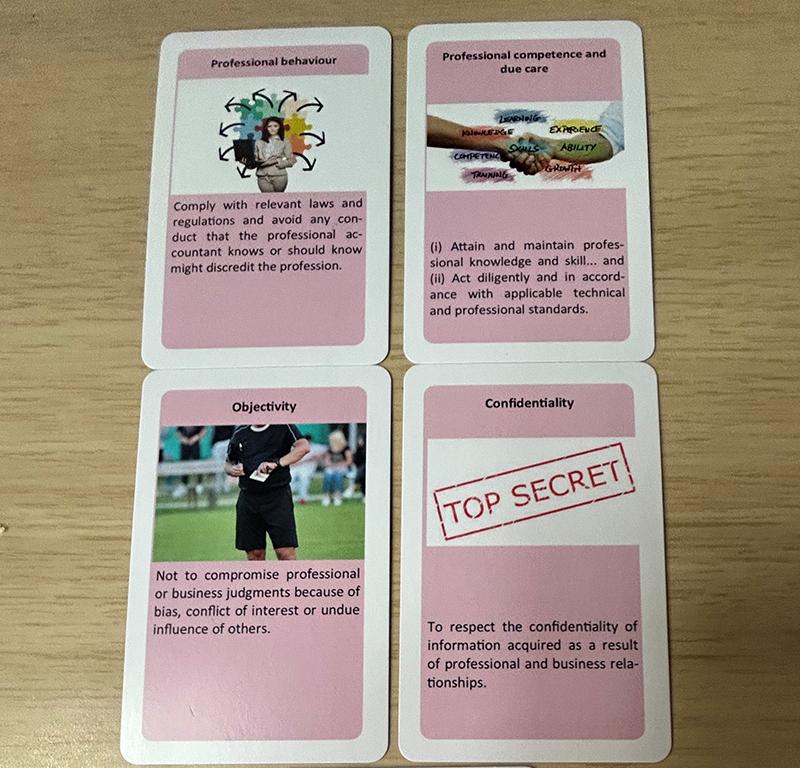
More importantly, it helps students see ethics as something they actively construct, not as something handed to them. Here are ways ethics cards can be integrated into teaching to build connection, deepen engagement and support meaningful ethical enquiry.
Use ethics cards as an icebreaker
A simple icebreaker is an easy way to start. Give each student a card as they walk in the classroom and ask them to find someone with a contrasting or complementary scenario or principle. Students introduce themselves, explain their card and discuss how they might respond to the dilemma. This gets students moving, talking and forming connections straight away.
Let students invent their own stories
Students are incredibly creative, and ethics cards give them a natural jumping-off point. Ask them to build a short narrative or scenario based on their card. For example, during an explanation of the dangers of accountants inadvertently speaking about their clients, students could be given a card with confidentiality on it. The students would need to consider scenarios where confidentiality could be an issue for accountants – for example, when talking to their family about a long day at the office. This can be done either individually, where each student gives a scenario and students discuss the implications of this, or in groups, so that collectively they understand the challenges.
With peer discussion, they can develop their own dilemmas, explore the tensions involved and talk through how they would resolve them. Group work energises the room with ideas. It also gives students protected time to get comfortable with the cards, play with the ideas and apply principles without fear of being “wrong”. This low‑pressure practice steadily builds their confidence in the subject area and prepares them for deeper ethical discussions.
Apply cards to ethical scenarios
Ethics cards are a powerful way to present ethical scenarios. Students use the cards either individually or in groups to apply ethical principles and safeguards to a situation from professional practice or current events. They then explain their responses. Multiple justifications will naturally enrich the discussion.
Different approaches from different students add a peer-learning dimension to this exercise. The cards provide options for how students contribute to the conversation, and the brief explanations on the cards give them confidence. The cards also allow for more variety in interpretations and approaches to ethical dilemmas, which mirrors real life.
Design an environment for dialogue and co‑created knowledge
Ethics learning thrives on conversation. Use the cards to prompt collaborative tasks, such as ranking dilemmas by complexity, mapping stakeholders or debating potential responses. Joining students at their tables reinforces the idea that you’re exploring alongside them. It turns learning into a shared endeavour.
Harness storytelling and humour
Storytelling and humour can make ethics more approachable. Share a quick anecdote linked to a card or invite students to add imaginative (or humorous) twists to their scenarios. These moments help build rapport and make difficult ideas easier to grasp.
Integrate personal experience
Encourage students to connect cards to their own experiences from work, volunteering or everyday life. This helps them recognise ethical reasoning as something they already use, strengthening understanding and relevance.
Building ethical learning communities
Students need to feel comfortable enough to participate, open enough to share ideas and confident enough to explore uncertainty. Used thoughtfully, ethics cards help create classrooms where students feel connected, engaged and respected. They turn ethical enquiry into a collaborative, human process built on curiosity and conversation. With each card chosen, shared and debated, students learn not just ethical theory but the habits of listening, reasoning and empathy that underpin professional and civic life. In the process, they help build a learning community where all voices matter, and where ethics is something everyone can literally hold in their hands.
Catriona Hyde is associate professor in accounting and finance in the School of Business at the University of Leicester.
If you would like advice and insight from academics and university staff delivered direct to your inbox each week, sign up for the Campus newsletter.



comment